Jargons
What are Junk Bonds?
Junk bonds are bonds rated below “investment-grade” that offer a higher yield or return than other “high-rated” or “investment-grade” bonds. These are high-risk bonds that also give high returns.
Key takeaways
- Junk bonds are bonds rated below “investment-grade” that give a higher yield or return than other “high-rated” or “investment-grade” bonds.
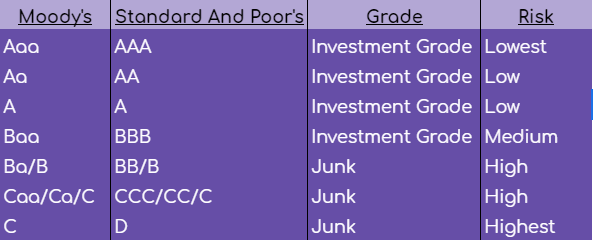
- Investment grades are those stocks that are rated above ‘BBB’ by Standard and Poor or Moody's, with anything below this 'BBB' rating considered a non-investment grade.
- A company’s bonds’ credit rating is subject to factors like ability to pay lenders, liquidity management, interest and tax management, regulation and competition, financial flexibility, and ability to generate cash flows, profits, or revenue.
- One should invest in junk bonds when there is an expansionary policy or quantitative easing in the market, or whenever the Government has put money in the market.
- It is recommended that a bond investor looks through market rates, industry conditions, company's credit history, and financials before investing in any high-risk bonds.
We have already studied in-depth what bonds are in this article. Bonds are basically companies raising debt from the public rather than going to a bank.
Now, what if a company issues a bond with a yield of 1%? No one will subscribe to it as better investment opportunities are available. What if a failing company offered you 8% returns if you subscribe to their bond? Will you buy it, considering the high risk? What if it offered a 20% yield as they were desperate for money? This is what a junk bond is.
Junk Bonds are those bonds that are rated below “investment-grade” that give a higher yield or return than other “high-rated” or “investment-grade” bonds. These are high-risk bonds that also give high returns.
Investment grades are those stocks that are rated above ‘BBB’ by Standard and Poor or Moody's. Anything below this 'BBB' rating is considered a non-investment grade. Any bond is subject to credit risk and default risk. To put it in simple words, bonds are used by corporates to ‘borrow’ money from people or institutions. If a company fails to pay back its lenders or pays less than what it ‘promised’, its credit rating decreases.
A company’s bonds’ credit rating is subject to many factors like:
- Ability to pay its lenders
- Liquidity management
- Interest and Tax management
- Regulation and Competition in the market
- Financial flexibility
- Ability to generate cash flows, profits, or revenue
If a company fails to meet the above metrics, it could be rated as a ‘Junk Bond’.
Should I Invest In Junk Bonds?
A company issuing bonds might get caught up in poor credit ratings by agencies despite having strong financials if all other companies in the industry are performing badly. This would be a good investment opportunity since despite having bad ratings, the company had good financial health and paid high returns at the same time.
A bond becomes junk whenever the company’s probability of paying its bondholder decreases. One should invest in junk bonds when there is an expansionary policy or quantitative easing in the market or whenever the Government has put money in the market Why? One simple reason, whenever there is money in the market, the economy is growing, businesses prosper and they make money. Companies are less likely to default on payments or more likely to give their bondholders a good return. The increase in demand for these bonds also increases their face value.
The increased demand for the bond results in rising prices and falling yields. Despite falling yields, the price increase gives a good return to an investor. To summarize, one should buy junk bonds in the expansion phase of the business cycle.
It is recommended that a bond investor looks through market rates, industry conditions, company's credit history, and financials before investing in any high-risk bonds.
Frequently asked questions
What are junk bonds?
Junk bonds are those bonds that are rated below “investment-grade” that give a higher yield or return than other “high-rated” or “investment-grade” bonds.
What is considered an investment-grade rating?
Investment grades are those stocks that are rated above ‘BBB’ by Standard and Poor or Moody's.
When should one invest in junk bonds?
One should invest in junk bonds when there is an expansionary policy or quantitative easing in the market or whenever the Government has put money in the market.
Written by
Maarg VaidyaRelated reads

What are Technical Indicators: Definitions and Types?
Understand technical indicators: what they are, how to plot them, their types (overlays, underlays, lagging, leading), and tips for effective use in trading.

What is Volume in the Stock Market? How to Analyse It?
What trading volume means, why it confirms or rejects a price trend, and how to apply volume analysis and the Volume Profile in real trades.

The BEST Framework to Create a Diversified Stock Portfolio
Learn the best framework to create a diversified stock portfolio for long-term success. Understand asset, market cap, and sectoral diversification for optimal returns.
Join 2.4M+ Indians · Free · 2 min