Editorial
The Crisis At The Suez Canal: Explained
A giant container ship has remained wedged in the Suez Canal for almost a week, causing major delays in global trade. This article dives into the details surrounding this crisis and its disruption to global trade.
On this page
Key takeaways
- The Suez Canal is a 193-kilometer-long man-made waterway connecting the Mediterranean Sea with the Red Sea, crucial for cargo ships between Asia, Europe, and the eastern United States.
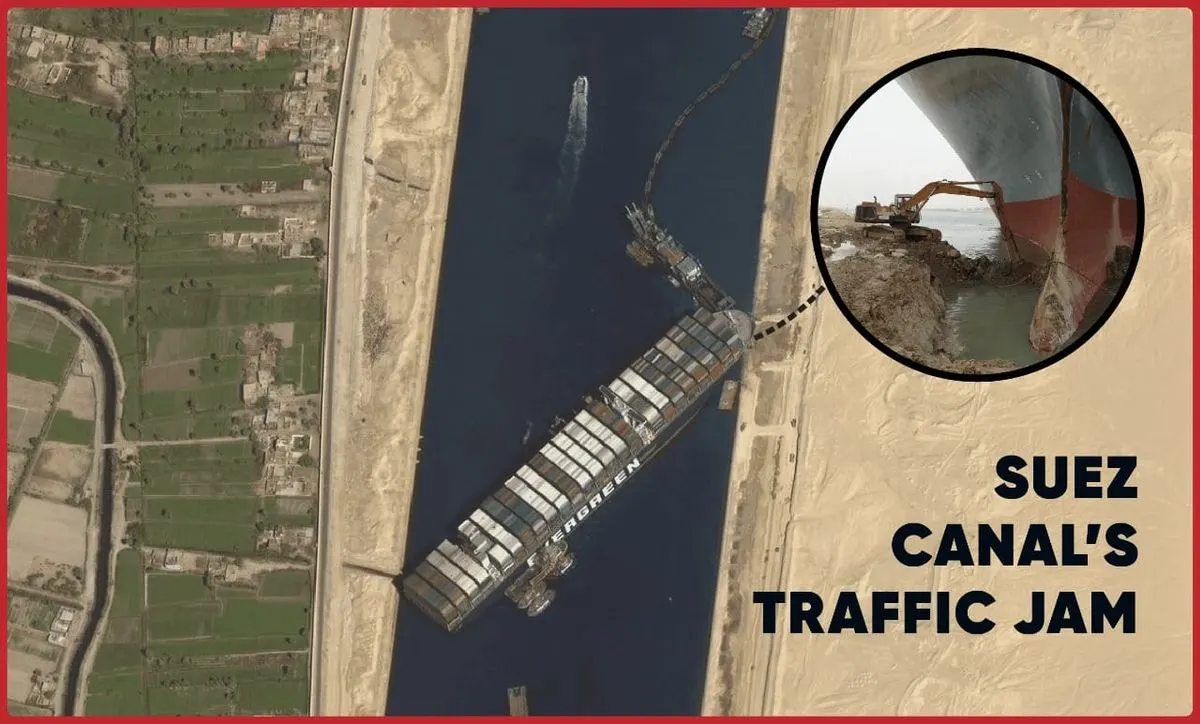
- The MV Ever Given, a 400-meter long container ship, got stuck diagonally across the single-lane southern stretch of the canal on March 23 due to high winds and a dust storm.
- The blockage has led to hundreds of vessels waiting, causing concerns about global energy markets and potentially spiking crude oil prices.
- The Suez Canal route is used for Indian exports/imports worth approximately $200 billion to and from North America, South America, and Europe, with India being the top importer of crude oil via this canal.
- Efforts to refloat the Ever Given have begun, with reports indicating the ship's course has been corrected by 80%.
A giant container ship has remained wedged in the Suez Canal for almost a week now. Hundreds of other vessels are piling up on both sides of the 150-year old canal, which is causing a major delay in the global trade of essential goods. Let us dive deep into the details surrounding this crisis, and find out how global trade has been disrupted.
The Suez Canal
The Suez Canal is one of the most strategic waterways that connects the Mediterranean Sea with the Red Sea. The 193 kilometer-long man-made waterway cuts through Egypt and makes a key transit point for cargo ships between Asia, Europe, and the eastern United States. It entered service in 1869 and is currently owned and operated by Egypt’s Suez Canal Authority. The canal’s location makes it an important link for shipping crude oil and other essential goods from countries in the Middle East (primarily Saudi Arabia, Iraq) to different parts of Asia and Europe. About 12% of overall global trade passes through the Suez Canal each year. An average of 50 ships, carrying about $9.5 billion worth of goods, passes through the canal every day.
Without the Suez Canal, a supertanker carrying crude oil from the Middle East to Europe would have to travel an extra 6,000 miles around Africa’s Cape of Good Hope. This would lead to an additional $300,000 (~Rs 2.17 crore) in fuel costs.
‘The Beached Whale’
MV Ever Given, a shipping vessel operated by Taiwan-based Evergreen Marine Corp, was passing through the Suez Canal on March 23. The vessel was en route from China to Rotterdam, Netherlands. It is one of the world’s largest container ships— about 400 meters long and weighs nearly 224,000 metric tonnes. To give some perspective, Ever Given is longer than the Eiffel tower and bigger than three football fields. On that particular day, the vessel got stuck In shallow mud, diagonally across the single-lane southern stretch of the canal due to high winds and a dust storm. As the Suez Canal is only 738 feet wide, the large ship cannot turn around within the narrow aquatic boundaries. It has completely blocked the entire waterway, and other ships carrying billions of dollars worth of goods cannot pass through.

Bernhard Schulte Shipmanagement, the company that manages the Ever Given, said the ship’s 25-member crew were safe. Dredgers are trying to clear the bottom of the channel and loosen the vessel to pull it out. According to reports, an elite ‘salvage squad’ began working towards moving the Ever Given from the bank of the canal. However, it has proved to be a rather tricky engineering and logistical challenge. The weight of the ship had to be reduced by taking off fuel and cargo. Officials were also hoping for a higher-than-normal tide over the weekend to lift the ship free.
Impact on Global Trade
On March 24 (Wednesday), close to 200 vessels were waiting to cross the canal. This figure has been increasing day-by-day. This includes bulk carriers, container ships, and oil or chemical tankers. As mentioned before, oil refiners across the world use this route extensively. Other points such as the Panama Canal, Strait of Hormuz (between the Persian Gulf and Oman), and Malacca Strait (between Indonesia and Malaysia) have also become highly congested. As a result, there are rising worries that global energy markets could be affected by the blockage. Crude oil prices, which were already quite volatile before, could spike to higher levels. However, analysts say that the Covid-19 induced lockdowns are a much bigger threat to the oil market.
As per reports, the blockage at Suez Canal is costing ~$400 million (~Rs 2,897 crore) an hour! The delay in the delivery of oil, petroleum, medical supplies, and food items to major markets around the world will surely lead to a surge in shipping costs. When it comes to importing goods from Asia to Europe, there are virtually no alternatives such as rail or truck transportation. As the canal stays closed, vessels will be diverted and go around the Cape of Good Hope— which adds around 7-9 days to a trip.
Shipowners or importers can hold Evergreen accountable for the delays and claim insurance. However, there is no clarity as to what will actually be covered. Moreover, many reports suggest that the canal being blocked would only lead to short-term disruptions. The long-term implications of this crisis will depend on how long it will last.
India’s Stance on The Suez Canal Blockage
The Suez Canal route is used for Indian exports/imports worth ~$200 billion to and from North America, South America, and Europe. This includes petroleum, organic chemicals, iron, steel, automobile, machinery, and textiles. India is the top importer of crude oil and products via the Suez Canal, higher than China, South Korea, and Singapore. More than two-thirds of our country’s crude comes from the Gulf region.
On March 27, the Indian government formulated a four-point plan to deal with the situation arising from the blockage of the Suez Canal. This includes:
- Prioritisation of cargo- Identifying cargo, particularly perishable cargo, for priority movement.
- The government is working and analysing channels to ensure that freight rates remain the same as per existing contracts.
- The Centre has made requests to the shipping lines to maintain stability in freight rates during the period of crisis.
- The government will explore the option of re-routing of ships via the Cape of Good Hope.
The meeting was chaired by the Ministry of Ports, Shipping & Waterways, Container Shipping Lines Association (CSLA), Federation of Indian Export Organisations (FIEO), and ADG Shipping.
Recent Developments
At last count, ~450 vessels were stuck, waiting, or headed to the Suez Canal. Other ships have diverted to the longer route around the southern tip of Africa. We are now receiving positive reports saying that the Ever Given has been partially refloated or freed. The Suez Canal Authority has stated that the container ship's course has been corrected by 80%. It added that efforts to fully refloat the vessel had begun. This raises hopes that the traffic along the canal could resume once the ship is moved to a waiting area.
Let us look forward to seeing how the situation unfolds in the days to come.
Frequently asked questions
What is the Suez Canal?
The Suez Canal is a 193-kilometer-long man-made waterway that connects the Mediterranean Sea with the Red Sea, serving as a key transit point for cargo ships between Asia, Europe, and the eastern United States.
What caused the blockage in the Suez Canal?
The MV Ever Given, a shipping vessel, got stuck in shallow mud, diagonally across the single-lane southern stretch of the canal due to high winds and a dust storm on March 23.
What is the impact of the Suez Canal blockage on global trade?
The blockage has caused hundreds of vessels to wait, leading to concerns that global energy markets could be affected, crude oil prices could spike, and shipping costs will surge due to delays in delivery of essential goods.
How is India affected by the Suez Canal blockage?
The Suez Canal route is used for Indian exports/imports worth approximately $200 billion, including petroleum, organic chemicals, iron, steel, automobile, machinery, and textiles, and India is the top importer of crude oil and products via this canal.
Written by
Cherian VargheseRelated reads
Natural Gas Trading: A Beginner’s Guide
Learn the basics of natural gas trading, including liquidity, volatility, derivatives, capital requirements, and factors influencing prices, in this beginner's guide.

Union Budget 2025-26: Key Highlights and New Tax Slabs Explained
Explore key highlights of the Union Budget 2025-26, including new tax slabs, sector allocations for agriculture, healthcare, defense, and infrastructure.

A Simple Guide to Trading Gold and Silver on MCX
Learn to trade gold and silver on MCX with this guide. Understand contract types, capital requirements, and factors influencing prices for profitable trading.
Join 2.4M+ Indians · Free · 2 min