Editorial
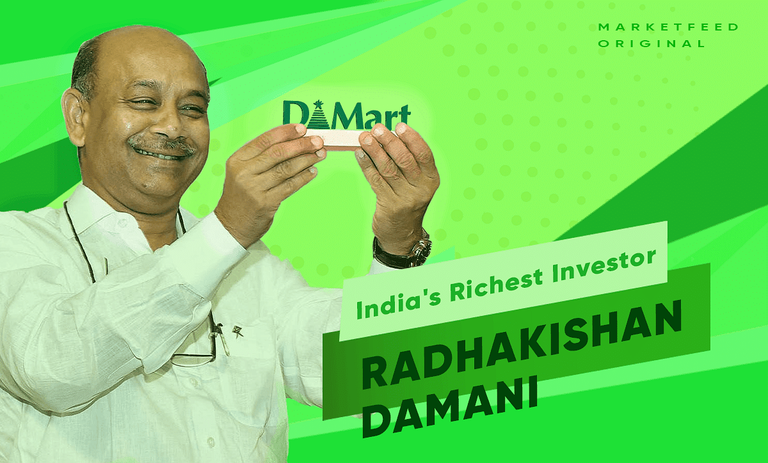
India's Richest Investor: Radhakishan Damani
Radhakishan Damani, known for his value investing principles, built DMart into India's largest retail supermarket chain. This article analyzes his investment journey and current portfolio.
On this page
Key takeaways
- Radhakishan Damani was born on January 1, 1954, in Mumbai and entered the stock market in his late 20s after his father's passing.
- Damani applied value investing principles, influenced by Chandrakant Sampat, and initially invested in companies like VST Industries, HDFC Bank, and Sundaram Finance.
- He founded DMart in 2002, which grew to 25 stores by 2010 and launched an IPO in 2017, raising Rs 1,870 crores.
- Damani's current portfolio is conservative, with mid-cap companies contributing 55% and large-cap 42%, and a beta of 0.7.
- His portfolio includes holdings in Avenue Supermarkets, VST Industries, India Cements, and Sundaram Finance, among others.
The Indian stock market is passing through a golden era. It has moulded sharp, disciplined, and inspiring investors over the years. Radhakishan Damani is one such individual who has taught us the beauty of value investing. He has applied analytical skills to build India’s largest retail supermarket chain, DMart. From living at a one-bedroom apartment in Bombay to owning 156 rooms at a Radisson Blu resort in Alibaug, his journey is inspiring for all stock market participants. In this editorial, we shall analyse Damani’s investment journey and his current portfolio.
Journey to Dalal Street
Radhakishan S Damani was born on January 1, 1954, into a Marwari family in Mumbai. His father, Shivkishanji Damani, worked as a stockbroker in Dalal Street. It is interesting to note that Damani was not enthusiastic about joining his father’s path. Instead, he pursued a Bachelor’s Degree in Commerce at the University of Mumbai. He always had a strong business acumen, which resulted in him dropping out of college and starting an enterprise in the field of ball bearings. Unfortunately, the passing of his father forced Damani into the world of the stock market in his late 20s.
Investment Journey
Damani was never satisfied with being a stockbroker. He started to analyse trading and investing activities in the Bombay Stock Exchange (BSE). During this period, the Indian stock market was controlled by a few powerful players. It was not open to foreign investors. He started getting exposure and insights from well-known personalities in Dalal Street such as Manu Manek (the Black Cobra) and Harshad Mehta (the Big Bull). Interestingly, Damani entered into short-sell positions in stocks that were manipulated by Harshad Mehta. He firmly believed that the stocks backed by Mehta were highly overvalued and would go through decent corrections.
In the l990s, Damani’s roots in value investing got deeper after meeting Chandrakant Sampat (a legendary value investor, started his investment career during the 1950s). VST Industries, HDFC Bank, Sundaram Finance, 3M India, Gillette, ITC, ICRA, CRISIL, Blue Dart are the stocks that were added to his initial portfolio. Damani found huge potential in HDFC Bank, at a time when public sector undertaking (PSU) banks such as State Bank of India (SBI) ruled the banking sector.
The Birth of DMart
Damani always wanted to start and grow his own venture. At the age of 45, he established a franchisee of Apna Bazar Supermarkets in 1999. After acquiring more knowledge of the Indian retail space and having disagreements with Apna Bazar's master franchisor, he decided to start a single-store supermarket named DMart in 2002. The company bought parcels of land to commence its operations. Now, DMart enjoys the benefits of land appreciation, which directly makes the balance sheet strong. Damani always focused on building the fundamental aspects of the business. From 2002 to 2010, there were 25 DMart stores across India.
DMart launched its initial public offering (IPO) in 2017 to raise Rs 1,870 crores at an issue price of Rs 299. The shares were listed on the exchanges at Rs 600. Currently, the company has a presence in 238 locations across 11 states in India. DMart is trading at ~Rs 3,970 in the NSE, giving the investors a Compounded Annual Growth Rate (CAGR) of 45% over the past 5 years.
Portfolio Analysis
Now, let us look at Damani’s current portfolio and look for some key patterns.
Damani is the major promoter of DMart. His holdings are worth around Rs 1,66,800 crore, which makes up 97% of his total portfolio. We can exclude it from our analysis as it will make other constituents negligible.

We can see that Damani is a conservative investor. Currently, mid-cap companies contribute 55% to his total portfolio, followed by large-cap at 42%, and small-cap at less than 2%.
Portfolio Diversification
Let us look at the segments he is betting big on:
| Stock | Segment |
| Avenue Supermarkets | Retail - Department Stores |
| VST Industries | FMCG - Tobacco |
| India Cements | Cement |
| Sundaram Finance | Consumer Finance |
| Trent Ltd | Retail - Apparel |
| United Breweries | Alcoholic Beverages |
| 3M India | Stationery |
| Blue Dart | Logistics |
| Metropolis Health care | Hospitals & Diagnostic Centres |
| Sundaram Finance holdings | Diversified Financials |
| BF Utilities | Renewable Energy |
| Astra Microwave | Communication & Networking |
| Mangalam Organics | Chemicals |
| Andhra Paper | Paper Products |
He has followed the same principle as his mentor Chandrakant Sampat:
“I will only buy those companies that are in a business that even fools can understand, have very little debt, have free cash flows, or do not have much capital expenditure”
Damani’s portfolio stocks have a low debt-to-equity ratio (debtless companies). Also, most of the mid-cap and large-cap companies mentioned above have a strong moat.
However, his holdings are highly sensitive to market conditions. The portfolio has a beta of just 0.7, which means that if NIFTY500 moves either upside or downside by 1%, his portfolio will react in the same direction with a lower magnitude of 0.7%.
Recent Purchases
Damani added a few stocks to his portfolio after the stock market crashed in March-April 2020 due to the Covid-19 pandemic. India Cements, Sun Pharma, Vodafone Idea, HPCL, Delta Corp, and DLF were purchased in March 2020. He also added Cochin Shipyard, India’s leading shipbuilding company in October 2020.
Portfolio Performance
It is interesting to see how Damani’s portfolio has performed over the past year. Let us take NIFTY500 as the benchmark to do a comparison.

Over the past year, NIFTY500 has surged 56%, while Damani’s portfolio grew 40%. Interestingly, the benchmark and portfolio have performed identically over the last 5 years.
Conclusion
There are a lot of takeaways from Damani’s journey in the stock market. He is conservative, patient, and disciplined. With the knowledge he acquired from large investors, he has been able to accurately analyse the financial performance and other fundamental aspects of companies. He has developed skills for identifying multi-bagger stocks. We can compare his portfolio with ours, and adopt essential features such as diversification and position sizing.
However, never jump into buying a particular stock just because Damani has added it to his holdings. Instead, we should understand the logic and reasoning behind why he chose that company and find its true potential. This will help us become intelligent investors.
Is your portfolio similar to Damani’s? Let us know in the comments section of the marketfeed app.
Frequently asked questions
Who is Radhakishan Damani?
Radhakishan Damani is an Indian investor who built India’s largest retail supermarket chain, DMart, and is known for his value investing approach.
When was Radhakishan Damani born?
Radhakishan Damani was born on January 1, 1954.
What is DMart?
DMart is a single-store supermarket chain established by Radhakishan Damani in 2002, which has grown to 238 locations across 11 states in India.
What is the beta of Damani's portfolio?
Damani's portfolio has a beta of just 0.7, indicating it reacts with a lower magnitude to market movements compared to NIFTY500.
Written by
marketfeed TeamRelated reads
Natural Gas Trading: A Beginner’s Guide
Learn the basics of natural gas trading, including liquidity, volatility, derivatives, capital requirements, and factors influencing prices, in this beginner's guide.
Union Budget 2025-26: Key Highlights and New Tax Slabs Explained
Explore key highlights of the Union Budget 2025-26, including new tax slabs, sector allocations for agriculture, healthcare, defense, and infrastructure.

A Simple Guide to Trading Gold and Silver on MCX
Learn to trade gold and silver on MCX with this guide. Understand contract types, capital requirements, and factors influencing prices for profitable trading.
Join 2.4M+ Indians · Free · 2 min